
May 2026, a scorched spring: scientists sound the alarm over our forests
A historic month, in figures
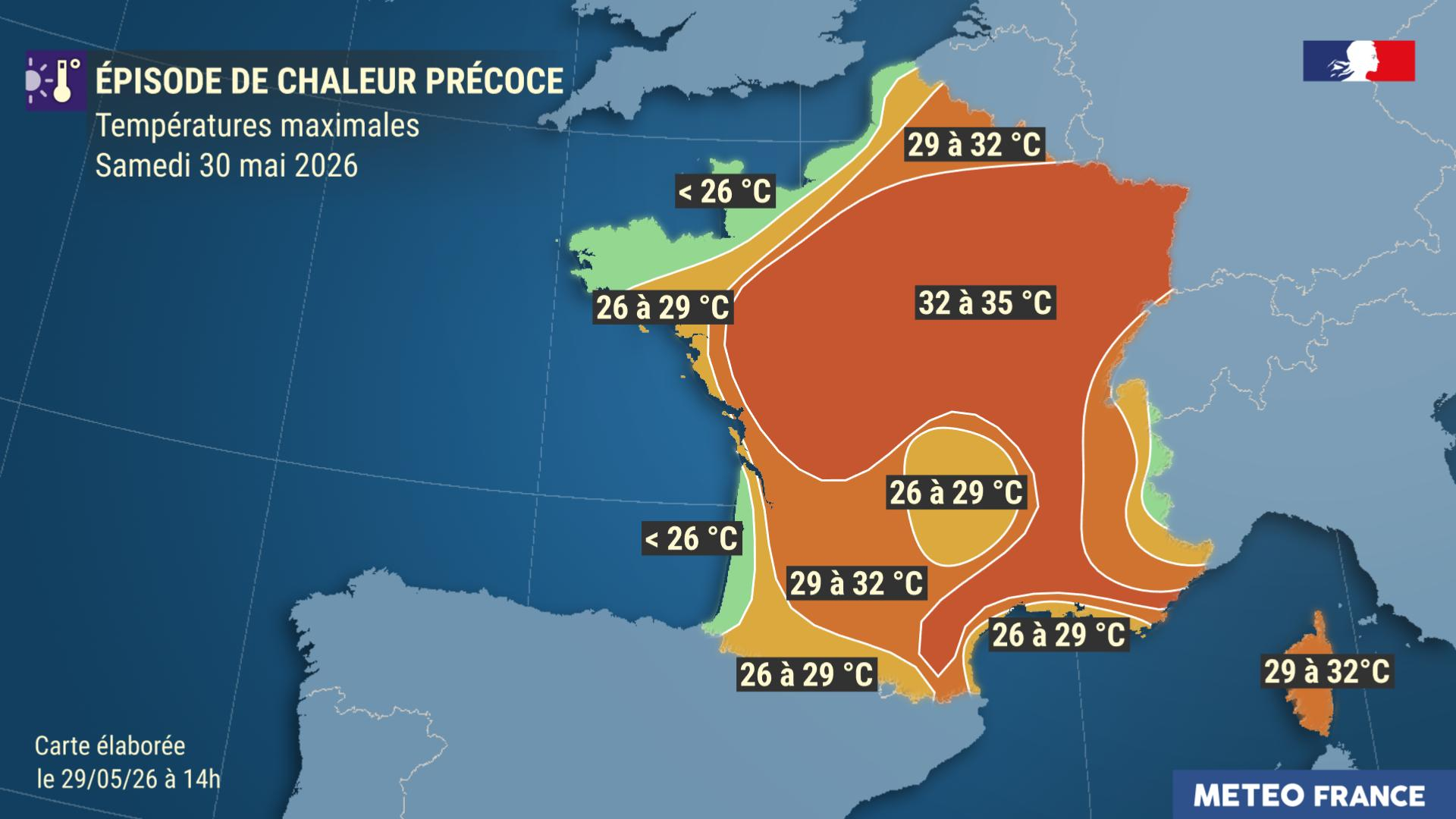
From 21 to 31 May 2026, French forests experienced a heatwave that Météo-France describes as "early, remarkable and lasting". The institute is now consolidating an assessment without equivalent at this time of year.
- 292 monthly maximum temperature records broken across a panel of around 600 stations between 23 and 28 May
- 37.8°C in La Couronne (Charente) on 28 May, which becomes the national record (excluding overseas territories) for a month of May, exceeding by nearly one degree the previous record held by Sollacaro (Corsica) with 37°C on 25 May 2009
- A national thermal indicator of 24.8°C on 26 May, the highest value ever recorded in France for a month of May since measurements began in 1947 (previous: 22.9°C on 28 May 2017)
- Temperatures 9 to 12°C above the 1991-2020 norms on the western side of the country
- Unusually warm nights: 22.1°C in Dinard, compared to a previous May record of 16.0°C
Climatologists estimate that this "unprecedented" episode has only a one in 1,000 chance of occurring at this time of year, based on records available since 1979.
To grasp the scale of the event: three records over a century old were broken during this sequence, including in Besançon where the thermometer surpassed its previous May record.
Why this episode is unprecedented
The physical mechanism is documented by Météo-France: a heat dome has been settled over France since 21 May. Warm air rises from Morocco via the Iberian peninsula, and remains trapped under high pressure that acts as a lid. The air is compressed towards the lower layers, which warms it further.
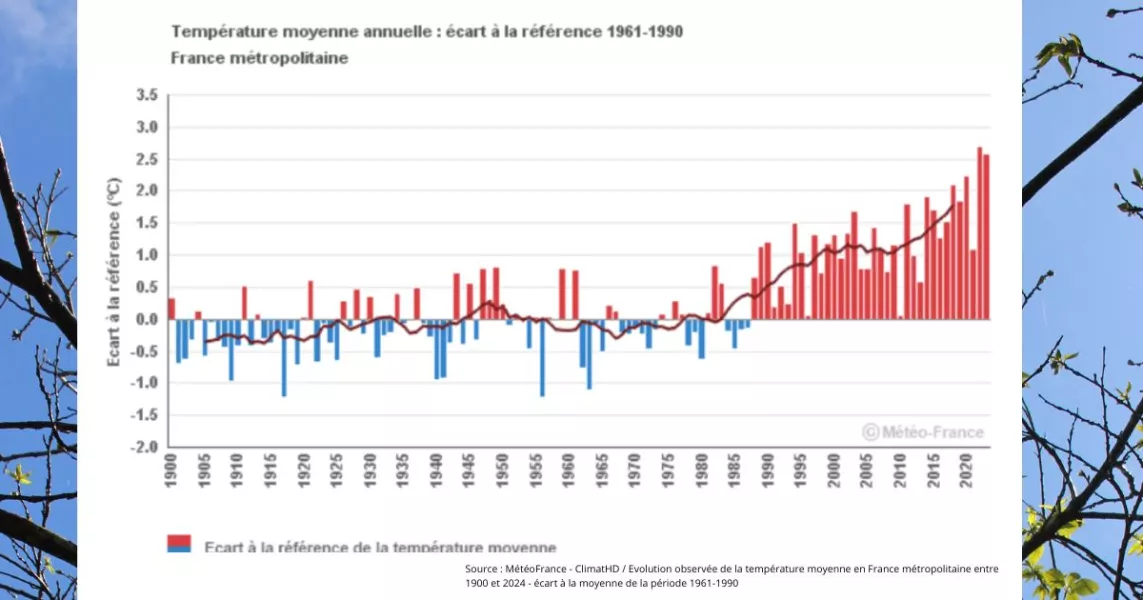
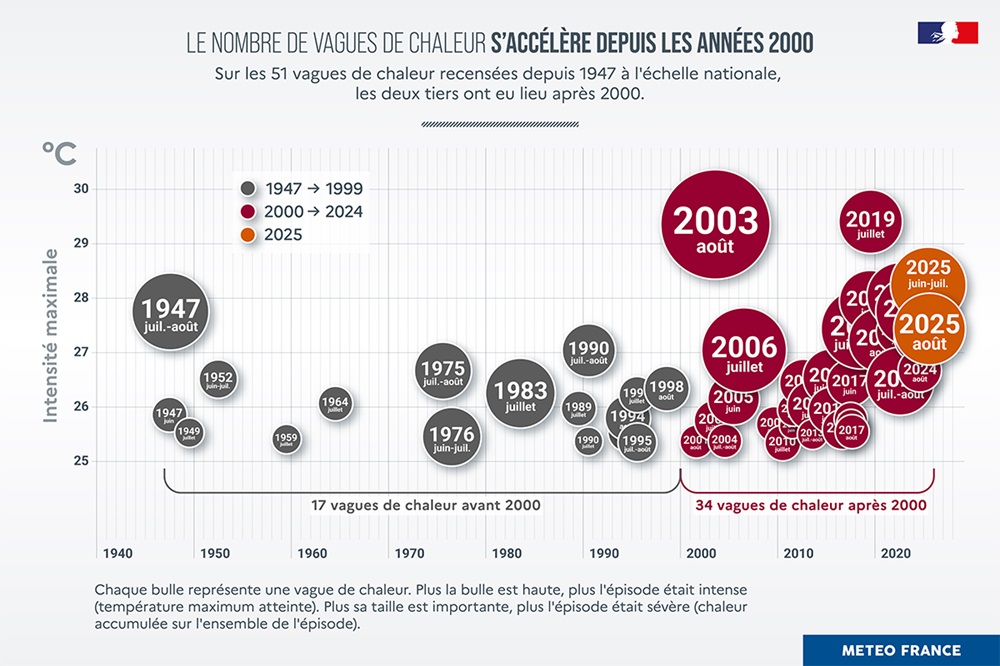
This atmospheric pattern is not new. What is changing is its frequency and intensity. Météo-France writes it explicitly: "With climate change, we expect to observe such heat episodes more and more frequently. They will be increasingly early and increasingly intense."
The European Copernicus service recalled in April 2026 that Europe is warming twice as fast as the global average since the 1980s, and that heatwaves are becoming more frequent and severe across at least 95% of European territory.
May 2026 is not an accident. It is a symptom.
Forests and the 2026 heatwave: what happens physiologically?
An early and lasting heatwave of this intensity does not only translate into thermometers running wild. For the forest, it is a major physiological stress, adding to already trying years.
Water stress at the worst possible time
In May, trees are in full budburst and new shoot growth phase. This is precisely the period when their water demand is highest. When soils dry out as early as spring, the water deficit sets in before summer has even begun.
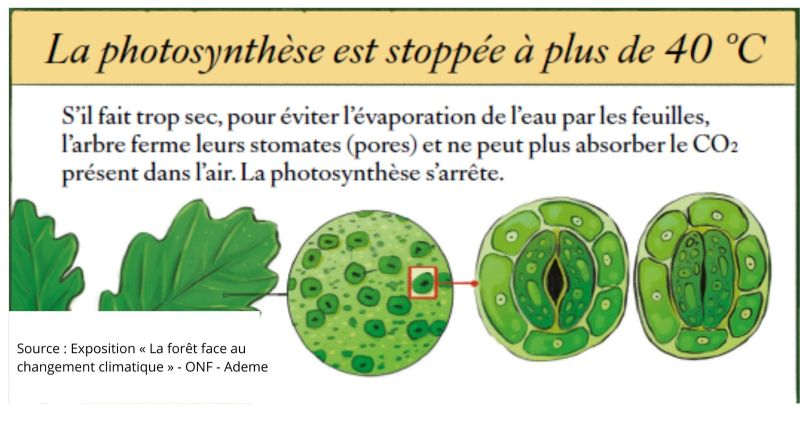
The mechanism is well known: when water is lacking in the soil and the air "draws" more moisture, the tree closes its stomata — those tiny openings in the leaves that allow gas exchange. It loses less water, but also absorbs less carbon dioxide, and therefore produces less sugar. Its growth slows down, its resistance to pathogens decreases.
A cumulative effect
The problem is not only the heat of May 2026. It is its accumulation with previous episodes.
According to the Office National des Forêts, more than 300,000 hectares of public forests in France have suffered an unprecedented mortality rate since 2018. The equivalent of 30 times the area of Paris. In certain emblematic massifs such as the Tronçais forest in the Allier, 15 to 20% of trees die before reaching maturity, and 30 to 40% of harvested wood is now declining.
An isolated heatwave, a forest can absorb. A heatwave adding to those of 2018, 2019, 2020, 2022, 2023, 2025, is something else. The multi-year repetition of stresses prevents recovery and reduces resilience.
Tree species in place that were not chosen for this climate
The forests we observe today are the result of management choices made 50 to 100 years ago, based on a climate that is no longer ours. The pedunculate oak, for example, planted for its growth qualities and rooting, is now showing its limits in stations where it becomes hydrically stressed.
Not all of France's emblematic forest species are doomed. But their suitability for the climate to come must be reassessed, station by station, soil by soil.
The urgency to adapt, not to replace
The temptation is strong, faced with this observation, to give in to either catastrophism or solutionism. Neither helps.
Catastrophism suggests that it is too late, that French forests are doomed. This is wrong: the French forest still possesses considerable genetic and ecological diversity, and many stands are holding up.
Solutionism suggests that planting trees is enough to solve the problem. This is also wrong: planting without a diagnosis, without choosing species suited to the station, without soil preparation, without long-term monitoring, means planting for nothing.
The reality is more demanding: adapting forests to the future climate is patient, technical work, that plays out plot by plot.
In concrete terms, this requires:
- A rigorous site diagnosis: soil, current climate, climate projected at 30-50 years, exposure, hydrology
- Species diversification: no longer betting on a single species, but composing mixed stands capable of absorbing varied hazards
- The choice of species adapted to climate evolution: native species from warmer provenances, or species at the southern edge of their current range
- Soil preparation that favours deep rooting, a condition for access to water during dry periods
- Sustainable management with a goal of irregular high forest with continuous cover where relevant, which maintains soil shade and moisture, limits evapotranspiration and preserves natural regeneration
- Support for existing natural regeneration, which is often already better adapted than plants of more northern origin
These are precisely the principles that guide the design of the projects we develop. A resilient forest is not a forest that you replace: it is a forest that you accompany, by playing on diversity, by respecting what already grows, and by anticipating the climate in which it will live.
The role of engaged companies
May 2026 must also be read as a signal for economic actors. The commercial window opened by the SBTi V2 (Net-Zero Standard), the CSRD, the EU anti-greenwashing directive and the revision of the Label Bas Carbone is clear: companies need to contribute to real, verified, sound carbon projects, aligned with the tightening European requirements.
French adaptive forestry projects tick all these boxes. They respond to a territorial emergency (adapting French forests) while generating carbon credits certified by the State under the Label Bas Carbone scheme.
For companies subject to SBTi trajectories, which must justify verified carbon removals by 2035-2050, every year counts. A plantation launched in 2026 will be in full sequestration at the time of the major deadlines. A plantation launched in 2030 will be much less so.
What we take away from this month of May
May 2026 will not have marked a tipping point — there have been others. It will have marked an additional acceleration of a trajectory we have known for years.
For French forests, the issue is no longer whether they will have to adapt. The question is whether they will be given the technical, financial and human means to do so in time.
At Atmosylva, we develop adaptive projects on the ground, in close cooperation with forest owners, managers and forestry experts, to turn this urgency into concrete action. If you would like to know more about how we design these projects, or if you are considering structuring your carbon contribution around verified French forestry projects, get in touch.
Main sources used:
- Météo-France, "Early, remarkable and lasting heat episode", 22 May 2026
- Franceinfo, "Map: a historic national average, hundreds of temperature records broken", 23-28 May 2026 summary
- Euronews, "May heat record: France put to the test by heatwaves", 26 May 2026
- ONF (French National Forests Office), "Climate change and forest decline: why we must act in the forest"
- French Forests Observatory, "Adaptation of forests to climate change"
- European Copernicus service, State of the Climate in Europe, April 2026