
French forests: a carbon opportunity within a clearer framework
In 2026, forest carbon contribution nonetheless retains a reputation for complexity. According to the InfoCC observatory, 46% of companies surveyed find it "complex to understand", and 52% cite the complexity of procedures.
So it is not the willingness to act that is lacking. It is the readability of the framework.
Yet that framework has become considerably clearer this year. Here are the four things to know before considering financing a French forestry project.
1. Forests have become the leading sector of the carbon market
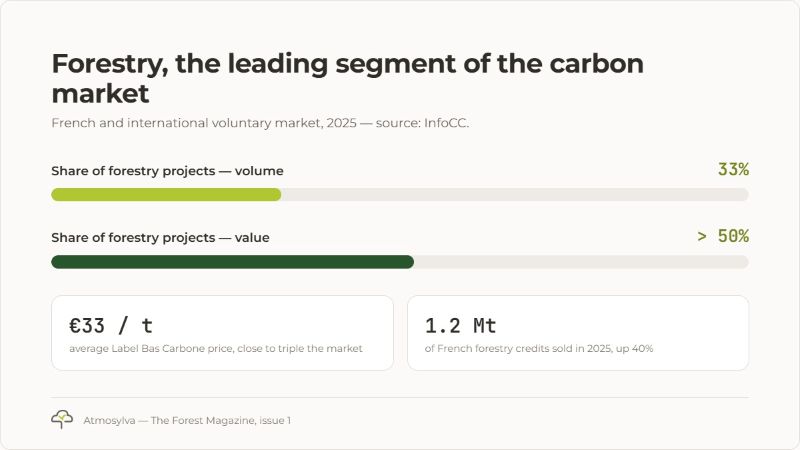
On the voluntary market observed by InfoCC, approximately 8 million tonnes of CO₂ were traded in 2025, for some 96 million euros, French and foreign projects combined.
Forestry projects account for one third of the volume and more than half of the value.
The Label bas carbone holds a distinctive position there: around 17% of volumes, but 46% of the value, at an average price close to 33 euros per tonne, nearly three times the market average.
On the French side, the volume of forest credits sold reached nearly 1.2 million tonnes in 2025, up 40%.
This momentum comes at a time when French forests are facing increasingly difficult summers. See our article: Fires 2026: what makes a forest flammable.
2. Carbon credits do not reduce your carbon footprint
This is the point most often misunderstood, and it deserves to be stated clearly.
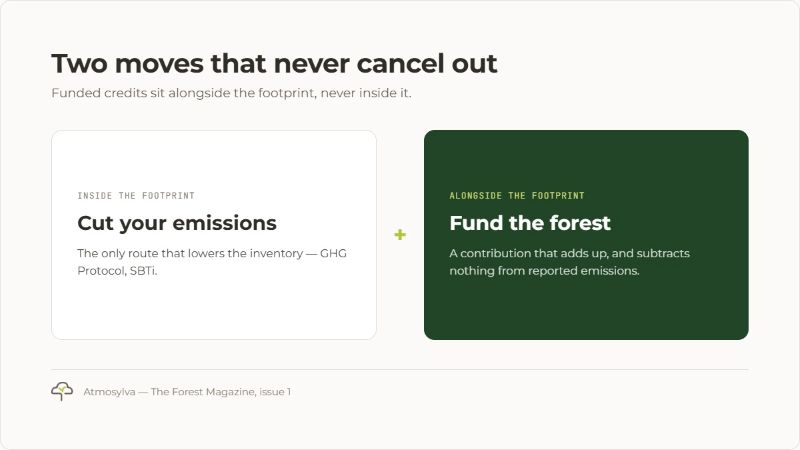
The credits a company finances do not reduce its carbon footprint. This rule applies under every framework: the French BEGES, the GHG Protocol and the SBTi standard all say the same thing.
Purchased credits are not deducted from the emissions inventory. They appear separately, alongside the footprint and not within it.
The company reduces its emissions on one side and finances projects on the other. The second action adds to the first, it does not diminish it.
Contribution or voluntary offsetting?
A question of vocabulary remains. French law and common usage distinguish two cases.
- Contribution is the default usage. It refers to support given to a project, without claiming to erase one's own emissions.
- Voluntary offsetting is more committing. It consists of setting verified credits against residual emissions.
In both cases, the inventory does not change. These are two ways of describing the same credits.
3. The SBTi V2 standard recognises forest financing
The central rule of the SBTi standard comes down to one sentence: a company cannot count any carbon credit towards its reduction targets. Reducing its own emissions comes first.
That leaves the emissions a company cannot yet avoid, its residual emissions. A new, voluntary mechanism invites it to take responsibility for these through contributions.
It is through this route that French forests find their place, via upfront project financing. Label bas carbone credits, sold before sequestration takes place, fall under this mechanism.
Two horizons, one deadline in 2035
The SBTi framework distinguishes two periods.
Until 2035, upfront financing is fully recognised. From 2035, the largest companies will have to support removals verified after the fact, in growing proportion.
Hence the value of committing early: a plantation launched today will be in full sequestration when those deadlines arrive. See our article: SBTi V2: reducing emissions and restoring forests
4. The CRCF reinforces the Label bas carbone
At European level, the CRCF regulation, which entered into force in 2024, establishes the first European, voluntary framework for certifying carbon removals.
Afforestation features within it, alongside agroforestry, peatland restoration and soil cover.
How does the Label bas carbone fit in? An application for the LBC to be recognised as a certification scheme under the CRCF is envisaged for early 2027. The aim is not to impose additional certification on project developers, but to ensure that projects already certified also meet European requirements.
One final point is worth knowing: the future European financial support mechanism will not target forests first. There is therefore no reason to wait for it before acting.
Why act now
Four reasons to act:
- A solid sector. Forests are the leading segment of the carbon market, and the Label bas carbone is the most highly valued within it.
- A framework becoming clearer. SBTi recognises upfront financing, and the CRCF articulates with the French label.
- Tightening demand. High-integrity forest credits are becoming scarce, and the most advanced players are already securing their supply.
- A deadline. From 2035, large companies will have to present verified removals. A plantation committed to today will be ready in time.
Going further
These four points set the framework. They do not explain how a Label bas carbone credit actually comes into being, what a company can declare in the registry and state publicly, nor how the SBTi mechanism works in detail.
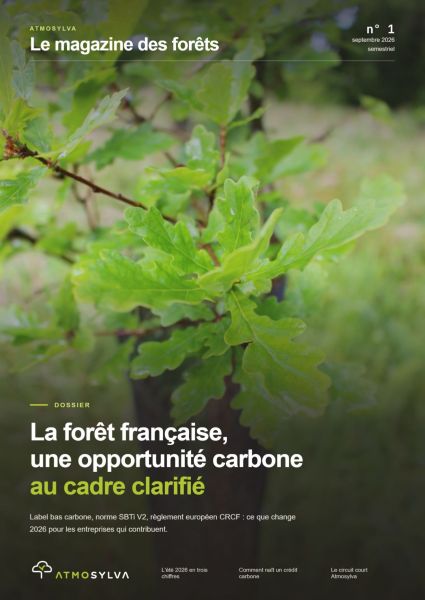
We have brought all of this together in the first issue of the Forest Magazine. Twenty-three pages, jargon-free, with thirty-one referenced sources.
| ➜ [Receive Forest Magazine No. 1] |